Start with the state you supply from and the goods or services you supply. In Telangana the ordinary threshold for taxable goods, services or both is more than Rs 20 lakh in a financial year. In Andhra Pradesh an eligible goods-only seller can use the Rs 40 lakh exemption. A compulsory registration rule can apply earlier.
Some goods, including ice cream, pan masala, tobacco products and certain bricks and tiles, are excluded from the higher limit. If you sell one of them, check the limit for that product and state before using Rs 40 lakh.
Which sales do I count?
Add up the value of the goods and services you supply across India under the same PAN. Include exempt supplies, exports and interstate supplies. Count each supply once. A stock transfer to a separately registered branch can count even if you did not sell the goods. See section 2(6) and Schedule I of the CGST Act.
Use the financial year you are checking.
Include once | Leave out |
|---|---|
Taxable and exempt supplies, exports and interstate supplies | GST, cess and inward purchases taxed under reverse charge |
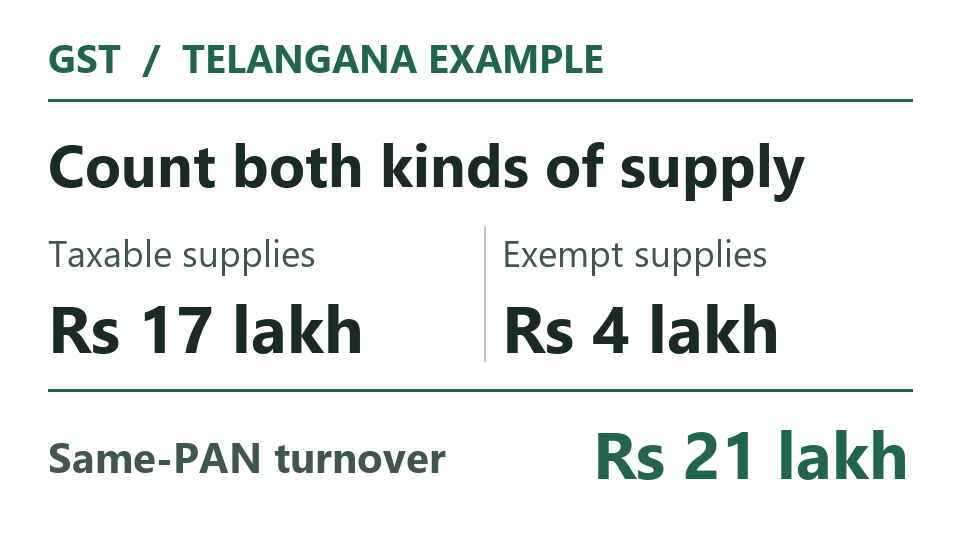
For example, a Telangana seller with Rs 17 lakh of taxable sales and Rs 4 lakh of exempt sales totals Rs 21 lakh. Selling only wholly exempt or non-taxable supplies is a separate exclusion. To use the higher goods-only exemption in Andhra Pradesh, check the exclusions in the goods threshold notification.
What if my customer is in another state?
First identify whether you supplied a service or moved goods. For a Hyderabad consultant with Rs 18 lakh of total PAN-wide turnover, an eligible service to a Bengaluru client can stay within the threshold exemption if no other compulsory rule applies.
Shipping taxable goods to a customer in another state generally requires registration even below the ordinary limit. Before using an exception, check that the notification actually covers your goods and the conditions of this sale. Keep the invoice or order and the dispatch details.
What if I sell goods through a marketplace?
For goods sold through a marketplace that collects tax at source, check all of these before the first sale under the exemption:
Your turnover stays within the applicable threshold in both the previous and the current financial year.
You make no interstate supply of goods and use marketplaces in only one state or union territory.
You declare your PAN and business details on the GST portal, obtain the enrolment number and supply through the marketplace only after enrolment.
If the platform asks for a GSTIN, check your eligibility against the marketplace notification and the enrolment you actually obtained. A marketplace enrolment number is distinct from a GST registration.
If you run a marketplace and must collect tax at source, register for GST under section 24.
When do I apply?
Write down the date your turnover first crossed the applicable limit or another registration condition first applied. An ordinary business has 30 days from that date to apply.
On the GST portal choose Services, Registration, then New Registration. Match legal name, PAN, state and premises proof.
Keep the application reference number (ARN). If the officer asks a question, compare the notice with the documents already submitted and respond by its stated date.
On approval, download the registration certificate and check the GSTIN, state and effective date. Then check which GSTIN to put on a customer's invoice.
Official references
- Who needs GST registration (opens in a new tab)
- Goods-only threshold rules (opens in a new tab)
- Interstate services (opens in a new tab)
- Marketplace exemption (opens in a new tab)
- New registration steps (opens in a new tab)
- CGST Act, sections 2(6), 24 and Schedule I (opens in a new tab)
- Additional goods excluded from the higher limit (opens in a new tab)